
Meet LockLLM: A Lightweight AI Security API
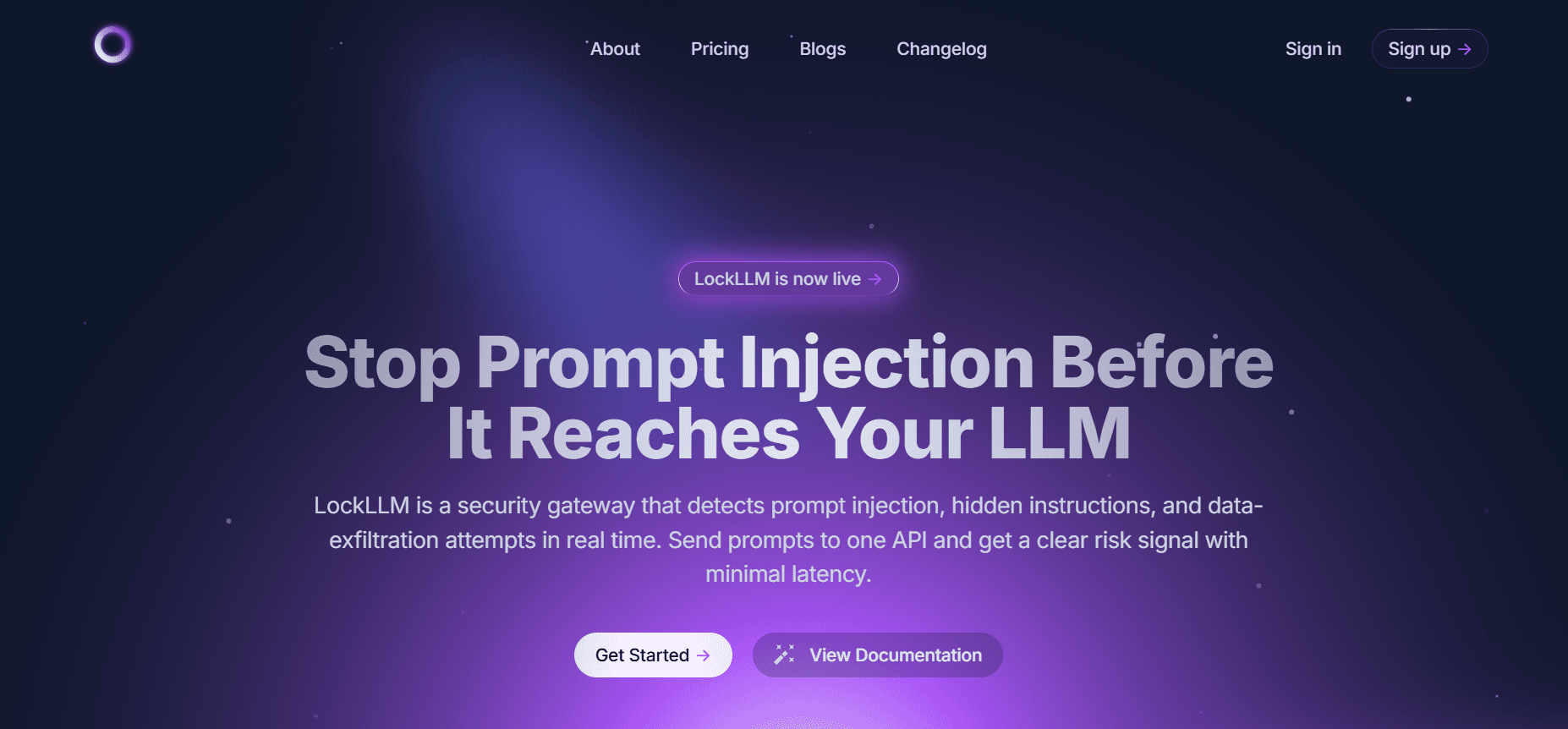
LockLLM v1 is officially released.
If you’ve ever shipped an LLM feature (chat, agents, tool calling, RAG, customer support bots), you’ve already met the problem: users will try to steer the model outside your intended behavior. Sometimes it’s accidental. Sometimes it’s creative. Sometimes it’s malicious.
LockLLM exists to solve that with a simple idea:
Scan every input before it reaches your model, and block or quarantine anything that looks like a prompt injection attempt.
Link to section: What LockLLM v1 doesWhat LockLLM v1 does
LockLLM v1 is a lightweight security layer you place in front of your AI stack. It works independently of your model - no retraining, no prompt rewrites, and no changes to your downstream provider.
With v1, you can:
- Detect prompt injection & jailbreak attempts (e.g., “ignore all previous instructions,” “reveal system prompt,” “bypass guardrails,” etc.)
- Score risk and decide what to do (block, warn, log, or route to a safer path)
- Add protection to any model/provider (OpenAI, Anthropic, Gemini, OpenRouter, local models, doesn’t matter)
- Centralize security for multiple apps using a single API key and consistent policy
Link to section: How it worksHow it works
LockLLM sits between your user and your LLM.
- Your app sends the user message to LockLLM.
- LockLLM scans the message with a dedicated prompt-injection detector.
- LockLLM returns a decision + risk score.
- Your app either:
- forwards the message to your LLM (safe), or
- blocks / asks for clarification / routes to human review (unsafe).
This pattern is simple, but it changes everything: your LLM never sees the dangerous input.
Link to section: What’s included in v1What’s included in v1
Link to section: 1) Scan endpoint (the core)1) Scan endpoint (the core)
LockLLM v1 exposes a scan endpoint that returns:
- whether the input is considered safe
- a label (safe vs injection)
- a confidence / injection score
- a request id for tracing & support
This is designed to fit cleanly into any backend - serverless, Node, Go, Python, you name it.
Link to section: 2) Middleware-friendly design2) Middleware-friendly design
LockLLM v1 is built to feel like “drop-in security”:
- one request in
- one response out
- your app stays in control of the final decision
You decide whether you want a strict block policy, or a softer “warn + log” policy for edge cases.
Link to section: 3) Developer-focused output3) Developer-focused output
Instead of a generic “blocked,” v1 is designed to support clarity:
- predictable JSON output
- stable fields for dashboards and analytics
- easy-to-log metadata (request ids, scores, etc.)
Link to section: 4) Performance-minded defaults4) Performance-minded defaults
Security tools only work if people actually keep them enabled. v1 focuses on:
- fast scan latency
- clear failure modes
- safe handling for large payloads (truncate instead of hard failing)
Link to section: Who v1 is forWho v1 is for
LockLLM v1 is useful anywhere you accept user-controlled text that will influence an LLM:
- Chatbots and support assistants
- Tool-using agents (especially with web browsing, code execution, or API actions)
- RAG systems (prompt injection through retrieved documents is real)
- Internal copilots and enterprise assistants
- Any “AI form field” embedded in a product workflow
If a user can type into it, someone will try to break it.
Link to section: Quick start mindsetQuick start mindset
LockLLM is not trying to replace your model, your prompts, or your existing safety layers.
It’s a front-door filter - one extra check that catches the most common and most damaging category of LLM attacks before they propagate through your system.
That means:
- fewer jailbreaks reaching your core prompt
- fewer "system prompt leaks"
- fewer tool-call exploits
- fewer weird edge cases that turn into incident reports
Link to section: What’s nextWhat’s next
v1 is the foundation. Next up on the roadmap:
- Policy modes (strict / balanced / permissive) with per-route overrides
- Better explainability (why something was flagged, without leaking detection tricks)
- Batch scanning for documents and RAG corpora
- Dashboard analytics (attack trends, top signatures, false positive tuning)
- Team + org features (keys, roles, usage visibility)
Link to section: Try LockLLM v1Try LockLLM v1
If you already have an LLM feature in production, you can add LockLLM in minutes and immediately reduce your exposure to prompt injection.
LockLLM v1 is live, and we’re shipping fast from here.
Have a feature request or a tricky injection you want us to test against? Send it over. We’re building this alongside real developers shipping real AI products.